Blog
In organizations subject to the requirements of NIS2, a cyberattack can result in loss of access to systems, disruption of operational processes, and an inability to deliver services. That is why business continuity under NIS2 has become such a critical issue, requiring organizations to implement and document incident response procedures. How can you prepare them to comply with the Directive while effectively protecting your organization during a crisis? Find out where to start.

Why is business continuity important in the context of NIS2 requirements?
Business continuity in an organization covered by NIS2 means the ability to maintain critical processes even in the event of a major disruption—regardless of whether it is caused by a cyberattack, a technological failure, or an unforeseen event. Any interruption in the availability of IT or OT systems leads to real operational, financial, and reputational losses. The Directive explicitly requires resilience, preparedness to respond to security incidents, and the ability to restore services quickly.
In practice, this means ensuring that the organization does not lose control over its infrastructure during a crisis. The paradox is that when the network stops working, the ability to repair it often disappears as well. That is why incident management under NIS2 must be supported by tools that provide asset visibility, alternative access paths, and documented recovery procedures. In this context, business continuity is not just a buzzword—it is a measurable defense mechanism.
How should you begin preparing for NIS2 with risk analysis and critical process identification?
Preparing to meet the requirements of the NIS2 Directive should begin with a thorough risk assessment and the identification of business-critical processes. The key is to determine which systems, services, and technological dependencies have the greatest impact on operational continuity, and then define disruption scenarios together with the potential consequences of each incident.
The next step is to establish clear recovery principles. Priorities should never be based on intuition—they must result from asset classification, business importance, and dependencies between services. The process should include both primary infrastructure and backup environments, data processing capabilities, and the readiness of alternative service providers.
At the same time, organizations should ensure the performance of information processing systems, communications infrastructure, and supporting environments. This includes maintaining both primary and backup systems, preparing failover mechanisms, and keeping backups in secure locations. Cooperation with external service providers should be formally regulated and include provisions ensuring service availability during crisis situations.
It is equally important to monitor and document the execution of the business continuity plan. Recording decisions, actions taken, and recovery times makes it possible to evaluate the effectiveness of procedures and continuously improve them. As you can see, preparing for NIS2 is not a one-time project but an ongoing process requiring continuous updates and complete operational oversight.
Which elements should be implemented first to comply with NIS2 requirements?
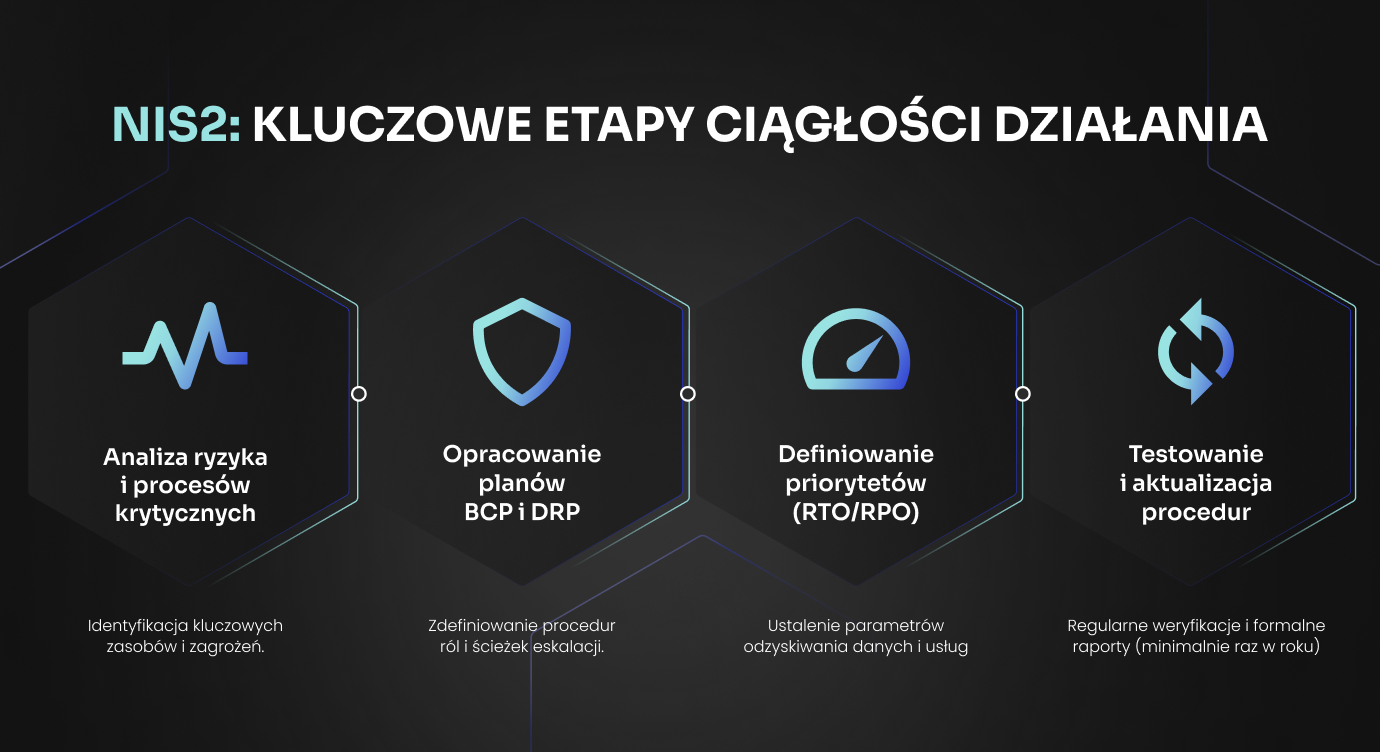
To effectively comply with the requirements introduced by NIS2, organizations should first establish the foundations of business continuity and disaster recovery. This starts with developing and formally approving a Business Continuity Plan (BCP) and Disaster Recovery Plan (DRP) based on the previously completed risk assessment. Without this foundation, documentation alone will have little operational value.
The next step is to clearly define roles and responsibilities within the incident response process. The crisis management team, decision-making authority, and escalation paths should all be established before an incident occurs—not during one. It is equally important to define the conditions for activating the continuity plan and the criteria for returning to normal operations.
Organizations should then establish recovery priorities by identifying the systems and processes that must be restored first, while defining Recovery Time Objectives (RTO) and Recovery Point Objectives (RPO) for critical services. Only then can appropriate resources such as backups, standby environments, redundancy mechanisms, and supplier support be planned effectively.
How should business continuity activities be documented for NIS2 compliance and audits?
Business continuity procedures should be documented in a structured and systematic way that clearly demonstrates compliance with applicable regulations. Every organization should maintain an up-to-date Business Continuity Plan (BCP) and Disaster Recovery Plan (DRP), both linked to the results of the risk assessment. Documentation should also include a register of identified risks together with evidence of compliance with adopted standards and best practices. This documentation serves as the primary source of evidence during audits and regulatory inspections.
How should procedures be tested and documentation updated in line with the NIS2 approach?
According to the NIS2 approach, both the Business Continuity Plan (BCP) and the Disaster Recovery Plan (DRP) must be tested and updated regularly to reflect the current state of the organization’s infrastructure and risk profile. Reviews should be performed at least once a year, as well as after significant security incidents, technological changes, or organizational changes. The review process should be based on incident records, change logs, and the results of previous tests.
Testing should verify the operation of backup environments, failover mechanisms, and the organization’s ability to restore systems to a defined operational state. Every exercise should conclude with a formal report, documentation updates, and a review of roles and responsibilities. Any changes should be communicated to operational teams to ensure that procedures remain aligned with the organization’s current architecture and operating practices.
How does OXARI help organizations meet NIS2 business continuity requirements?
OXARI supports organizations in the practical implementation of NIS2 requirements by combining comprehensive asset management with incident control and response capabilities. The Asset Management module provides up-to-date information about hardware and software assets, enables secure data management, and helps enforce security policies aligned with NIS2 requirements. Rapid identification of irregularities allows organizations to minimize the impact of incidents and maintain the business continuity that is essential for every organization.
Would you like to see how our solutions perform in your environment? Schedule a free consultation and discover how OXARI can streamline asset management and strengthen your organization’s operational resilience.